
Visuels à partager
Visuels générés automatiquement aux couleurs du CSIRT, prêts à diffuser sur WhatsApp, LinkedIn, X ou Facebook.




En bref
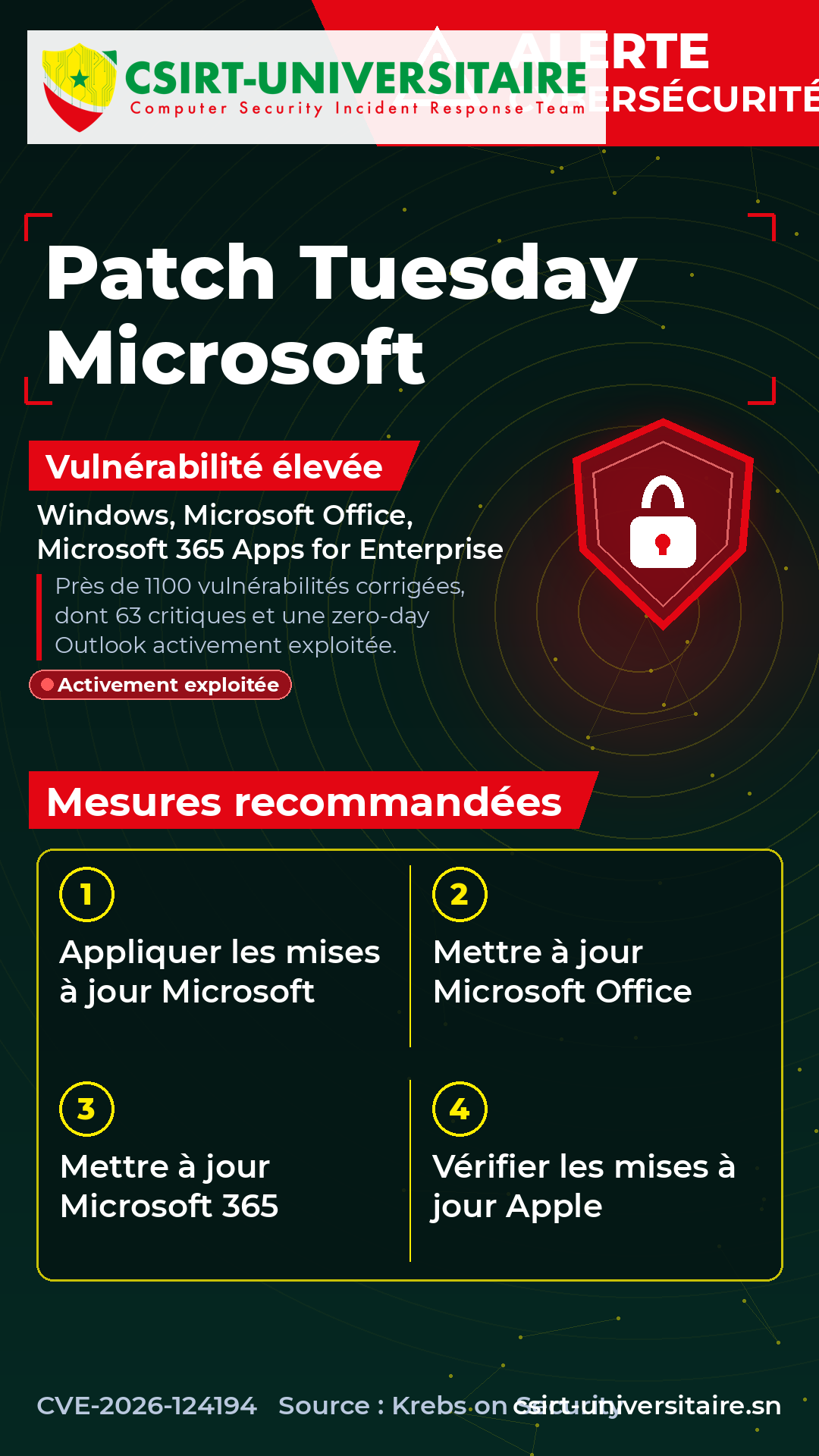
Microsoft a publié des mises à jour de sécurité massives, corrigeant près de 1 100 vulnérabilités, dont 63 critiques. Une vulnérabilité de type usurpation d'identité (spoofing) dans Microsoft Outlook (CVE-2026-124194) est activement exploitée et concerne les applications Microsoft 365 et Microsoft Office. Les administrateurs systèmes doivent prioriser l'application des correctifs pour protéger les systèmes Windows et les logiciels concernés.
En détail
Microsoft a publié des correctifs pour 1 093 vulnérabilités, dont 63 sont classées comme critiques. Parmi ces failles critiques, près de la moitié permettent l'exécution de code à distance, et 535 permettent une élévation de privilèges. Une vulnérabilité spécifique, CVE-2026-124194, est une faille de type usurpation d'identité (spoofing) dans Microsoft Outlook. Cette vulnérabilité est activement exploitée et a été ajoutée au catalogue CISA KEV. Elle est classée avec un score CVSS de 6.5 (CVSS:3.1/AV:N/AC:L/PR:N/UI:R/S:U/C:H/I:N/A:N), indiquant qu'un attaquant non authentifié peut l'exploiter via le réseau avec une faible complexité, nécessitant une interaction utilisateur, pour compromettre la confidentialité des données.
La description NVD pour CVE-2026-124194 indique que l'interface utilisateur du produit n'avertit pas l'utilisateur d'actions dangereuses dans Microsoft Office Outlook, permettant à un attaquant non autorisé d'effectuer une usurpation d'identité sur un réseau. Cette faille est de type CWE-356 (Absence d'avertissement pour les actions dangereuses).
Produits et versions concernés
- Microsoft 365 apps
- Microsoft office 2021
- Microsoft office 2024
Impact
Un attaquant peut obtenir une exécution de code à distance ou une élévation de privilèges sur un système Windows vulnérable. Spécifiquement pour CVE-2026-124194, un attaquant peut réaliser une usurpation d'identité, compromettant potentiellement la confidentialité des informations.
Exploitation
Exploitation active confirmée (catalogue CISA KEV) pour CVE-2026-124194. Aucune information n'est fournie sur l'exploitation des autres vulnérabilités mentionnées.
Mesures recommandées
- Appliquer immédiatement les mises à jour de sécurité Microsoft pour Windows et les logiciels supportés, en particulier celles concernant Microsoft Outlook.
- S'assurer que Microsoft 365 Apps for Enterprise et les éditions de Microsoft Office sont à jour avec les derniers correctifs.
- Mettre en place une stratégie de sauvegarde régulière des données importantes avant l'application des mises à jour du système d'exploitation.
- Sensibiliser les utilisateurs aux risques d'usurpation d'identité et aux actions potentiellement dangereuses dans Outlook, en attendant l'application des correctifs.
Vérifier son exposition
- Vérifier les journaux système et les journaux d'événements de sécurité pour toute activité suspecte ou tentative d'exploitation liée aux vulnérabilités Microsoft.
- S'assurer que les versions des produits Microsoft 365 et Office sont conformes aux versions corrigées par Microsoft.
- Utiliser des outils de gestion des vulnérabilités pour scanner les systèmes et identifier les installations de Microsoft Office et Outlook non corrigées.
Synthèse rédigée automatiquement à partir de la source officielle. En cas de doute, la source fait foi.
Fiche technique · CVE-2026-124194
| Score CVSS | 6,5 (Moyenne) · CVSS 3.1 |
|---|---|
| Vecteur d'attaque | Réseau (à distance) |
| Complexité | Faible |
| Privilèges requis | Aucun |
| Interaction utilisateur | Requise |
| Portée | Inchangée |
| Confidentialité | Forte |
| Intégrité | Aucun impact |
| Disponibilité | Aucun impact |
| Faiblesse | CWE-356 |
| Exploitation | Activement exploitée (catalogue CISA KEV) Apply mitigations in accordance with vendor instructions, ensuring compliance with CISA’s BOD 26-04 Prioritizing Security Updates Based on Risk (see URL in Notes) guidance and CISA’s “Forensics Triage Requirements” (see URL in Notes). Follow applicable BOD 26-04 guidance for cloud services or discontinue use of the product if mitigations are unavailable. Stakeholders are responsible for evaluating each asset's internet exposure and ensuring adherence to BOD 26-04 patching guidelines. |
| Publiée le | 2026-11-10 · mise à jour le 2026-11-11 |
Texte d'origine de la source (en anglais)
Microsoft did another four-digit patch drop today, releasing updates to fix almost 1,100 security vulnerabilities in its Windows operating systems and supported software. This month’s Patch Tuesday addresses 63 critical flaws - including a zero-day in Microsoft Outlook - and comes amid important security updates from other software makers, including Adobe , Apple , Google and Mozilla . Image: Shutterstock.com. Diorama by @zepp1969. November’s patch release from Redmond tackles 1,093 vulnerabilities, fixing 63 “critical” flaws that can be exploited to seize control over a Windows system with little or no help from users. Nearly half of those critical bugs are remote code execution vulnerabilities. Overall, 535 of the flaws addressed this month allow an attacker to elevate their privileges on a vulnerable device. This latest round of updates means Microsoft has shipped more than 5,100 security patches so far this year, a staggering number considering that a year ago Microsoft was averaging around 100 patches per month. Microsoft credits advances in artificial intelligence for helping to find (and fix) such a large volume of security bugs in recent months. Last month, Microsoft pushed more than 1,400 fixes. According to Redmond, just one of the flaws is already seeing active exploitation: CVE-2026-124194 , a spoofing bug in Outlook. The advisory for CVE-2026-124194 says it affects Microsoft 365 Apps for Enterprise and editions of Microsoft Office . Several other major software makers pushed security updates this week to fix critical weaknesses in their products. Apple on Monday released out-of-cycle security updates to fix at least nine vulnerabilities in iOS/iPadOS , macOS , watchOS and visionOS . Among the weaknesses reportedly fixed in Apple’s release include an iMessage flaw that could let a remote attacker join a group chat and receive its messages; the updates also fix a separate iMessage flaw that could let someone added to a group access messages sent before they joined. Lee Neely , an instructor at the SANS Institute , noted that Apple backported the fix to iOS 18. “I take notice when Apple releases fixes to more than two versions,” Neely wrote in a SANS newsletter today. “You really need to get to version 27.2.1 of their OSes and push folks who are holding onto devices which cannot run the current version. The best plan often involves setting an upgrade date for old hardware. Run through all your Apple devices and make sure everything is up to date, don’t assume the fixes went out automatically.” Google this week released Chrome version 157.0.8103.50 , which resolves nine security holes, including CVE-2026-125350 , the sixth zero-day vulnerability this year for Chrome (this bug also is being patched in Chromium-based browsers like Edge). The latest Chrome version follows its November 3 release, which fixed 213 vulnerabilities. A new version of Mozilla Firefox out today ( Firefox 160 ) resolves almost 100 CVEs, about half of them high severity. Adobe today released patches for at least 110 vulnerabilities across a range of products, with nearly half of the flaws rated high severity. Adobe said there is no evidence any of the security holes it addressed this month are being actively exploited. Chris Goettl , vice president of product management at Ivanti , said it’s easy for security teams at large enterprises to feel overwhelmed by the volume and criticality of patches from Microsoft lately. But he notes that while some 95,000 vulnerabilities have been assigned CVEs this year across all vendors, only 217 have so far this year been added to the Known Exploited Vulnerabilities (KEV) list maintained by the U.S. Cybersecurity and Infrastructure Security Agency (CISA). “Roughly four in ten of this year’s exploited vulnerabilities sit in operating systems, endpoint software, browsers, and server platforms, which a continuous patch strategy can close quickly,” Goettl said.”The rest calls for exposure management alongside patching, especially the 44% that sit in edge devices and IT management or remote access tools, the internet-facing systems that hold privileged access. Teams that can quickly identify those assets, confirm exposure and act on confirmed exploitation can focus on the small slice of vulnerabilities attackers are actively using, while the rest stays on the normal patch cadence.” Please don’t neglect to back up any important data if you haven’t recently; generally speaking, this is a task best accomplished before applying operating system updates. As ever, if you experience any issues installing this month’s bundle of love from Microsoft, please drop a comment about it in the space below.
Source
Krebs on Security · publié le 10 novembre 2026
Lire la source originaleRéférences complémentaires
- https://msrc.microsoft.com/update-guide/vulnerability/CVE-2026-124194 Vendor Advisory
- https://www.cisa.gov/known-exploited-vulnerabilities-catalog?field_cve=CVE-2026-124194 US Government Resource